
By: Nicsa Data Analytics Committee
Nicsa's Data Analytics Committee, comprising executives in the asset and wealth management community, presents the following insights around AI Governance:
On the presupposition that computers, and by extension artificial intelligence, cannot be held accountable either morally or legally, business owners, AI engineers, and other AI actors in the financial services industry face the same question:
Who is responsible for AI failure?
And just as importantly, how do we implement AI while mitigating risk?
Why “Failure” Isn’t Hypothetical
Failure may sound extreme, but in the context of intellectual property disputes, data governance pressures, and geopolitical dependencies across infrastructure and supply chains, it is entirely plausible.
The question is not whether failure can occur, but whether organizations are equipped to absorb and manage it. This makes governance a core priority, not a downstream consideration. A practical AI Governance framework should be anchored by two principles: Compliance and Ethics by Design and Interchangeability.
A Simple Framework for AI Governance
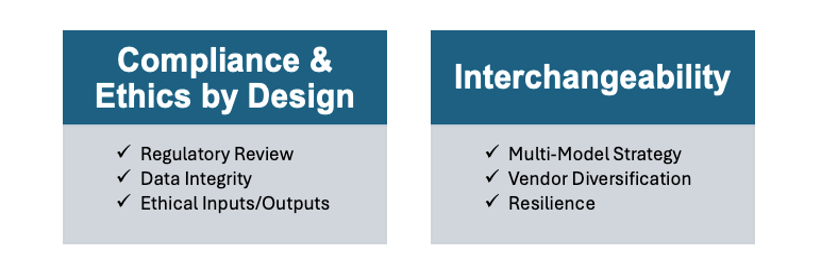
1. Compliance and Ethics by Design
2. Interchangeability
Taking the lessons learned in a study which used “Adversarial Poetry1” (harmful requests reformulated in poetic form) to circumvent current safety mechanisms to utilize AI chatbots for the creation of content beyond its safety training protocol, we ought not to assume that current alignment methods and evaluation protocols are sufficient in defending against misuse. Independent consideration and review for regulatory (accounting for the possibility of stronger regulations in the future) and ethical compliance of AI models and platforms should be integrated into the onboarding process.
This consideration should include assessing risks related to the generation or replication of protected intellectual property, as well as the use of proprietary data in training and agent-driven workflows. It also requires deliberate oversight of both inputs and outputs, including how results are interpreted and applied. In this context, data quality and integrity are not just technical concerns, but core governance priorities that underpin reliable model performance and responsible business use.
Governance as Risk Management
Framing governance as a core element of risk management and business continuity expands the focus beyond inputs and outputs to include the models themselves and the providers behind them.
As AI adoption matures and scaling begins to plateau, a shift toward smaller, task-specific or locally deployed models offers clear advantages in resilience. Compared to reliance on large, generalized systems, these approaches reduce dependency risk and improve overall operational stability.
Where Governance Fits in Practice
At the enterprise level, diversifying across models and model families (AI models with shared origins and architecture), supported by infrastructure designed for interchangeability, enables more agile model selection within workflows. This approach reduces concentration risk as AI becomes embedded in critical operations and mitigates disruption from large-scale outages.
Closing Thought
While questions around AI risk remain, best practices will evolve with the technology. The immediate priority is clear: balance value and risk through disciplined governance. In the end, success will not be defined by how much AI is adopted, but by how well it is governed.
Looking Ahead
Nicsa’s Data Analytics Committee remains focused on fostering collaboration across executives in the asset and wealth industry. The Committee looks forward to continuing this dialogue in future meetings and encourages members to bring colleagues and new perspectives into the discussion. For information about how to get involved in Nicsa’s Committee, reach out to i[email protected].


Website Design By Branophia LLC