
By: Nicsa Data Analytics Committee
Every financial organization has more data than ever, but the real advantage comes from knowing how to use it with purpose. What once felt like a specialized technical discipline has become an essential business capability for professionals across operations, compliance, client service, and investment teams. As markets move faster, regulatory expectations grow, and AI becomes part of everyday workflows, data analytics is no longer just about reporting what happened. It is about building the skills, judgment, and collaborative mindset needed to turn information into trusted decisions and meaningful innovation.
In today’s hyper-connected digital economy, data is often described as the new oil. A more accurate view is that it serves as a raw energy source that powers decision-making. Across financial services and asset servicing in particular, data is not abstract. It sits at the center of operations, supporting everything from compliance monitoring to investment strategy execution.
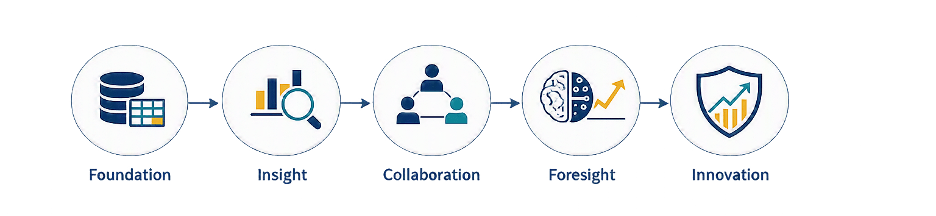
The data analytics journey moves from foundational skills
to trusted financial innovation.
For example, firms are using analytics to flag suspicious trading activity in near real time, reducing regulatory risk, while portfolio managers rely on data models to rebalance assets based on shifting market conditions. These are not future-state ideas, they are already embedded in daily workflows.
Defining Data Analytics in a Complex World
Data analytics goes far beyond charts and spreadsheets. It is the end-to-end process of examining raw data to uncover patterns, generate insights, and support informed decision-making. This includes data preparation, statistical analysis, and predictive modeling.
In financial services, this process transforms large volumes of data such as trade records, client information, market data, and regulatory inputs into actionable business intelligence. A common use case is client segmentation, where firms analyze behavior and transaction history to tailor products or outreach strategies. Another is operational efficiency, where analytics helps identify bottlenecks in trade processing or settlement cycles.
The Path to Upskilling: Building the Maker Mindset
As industries continue shifting toward AI-driven workflows, the demand for data skills has accelerated. Professionals increasingly need to move from passive consumers of data to active builders of analytical solutions.
Automation and Visualization Tools: Platforms like Alteryx and Power BI enable efficient data preparation, blending, and visualization, turning complex datasets into interactive insights. For instance, operations teams can automate reconciliation processes and surface exceptions through dashboards instead of manual reviews.
Programming Foundations: Python has become a core language in analytics due to its flexibility and strong ecosystem, supporting everything from automation to machine learning. A practical application is building scripts that pull and clean market data daily, feeding directly into risk models.
Continuous Learning: Online platforms such as Udemy provide accessible entry points for building both practical and theoretical knowledge. Many professionals apply these skills immediately, such as creating small forecasting models to support budgeting or scenario analysis.
The Role of Community and Collaboration
Technical skills alone are not enough. Progress in data analytics is often driven by shared knowledge and real-world application.
Industry groups, such as the Nicsa Data and Analytics Committee, help bridge theory and practice by enabling professionals to exchange insights, use cases, and challenges. These forums often surface practical applications, like how firms are standardizing ESG data reporting or using shared frameworks to improve data governance.
Collaboration also accelerates innovation. A solution developed for one use case, such as automating client reporting, can often be adapted across teams or even across organizations.
The Next Phase: From Insight to Foresight
As foundational skills mature, the focus shifts from understanding past performance to shaping future outcomes.
AI and Machine Learning: Enables predictive and prescriptive analytics to anticipate trends and guide decisions. For example, firms are using machine learning models to predict client churn or identify which accounts may require proactive engagement.
Generative AI in Workflows: Redefines how data is accessed and used, including automation and improved discovery. Analysts can now query complex datasets using natural language, significantly reducing the time required to generate insights.
Ethical AI and Data Governance: Ensures transparency, accountability, and trust in advanced analytics. This is especially critical in use cases like credit decisioning or fraud detection, where biased or opaque models can introduce risk.
The Path Forward: Resources and Ecosystems
The data analytics journey is continuous and supported by a growing ecosystem of tools and communities.
Industry engagement through groups like the Nicsa Data and Analytics Committee, where real-world applications and lessons learned are shared.
Advanced education platforms such as Coursera and edX, often used to build specialized skills like machine learning or data engineering.
Developer and research communities like GitHub, Stack Overflow, and arXiv, where practitioners collaborate and refine solutions.
Looking Ahead
The data analytics journey doesn't end with dashboards or reports. It continues as organizations turn insights into action and embrace new technologies that make better decisions possible.
The greatest value comes from combining strong data practices with curiosity, collaboration, and a willingness to adapt. As AI and predictive analytics become more accessible, organizations that build a solid foundation today will be best positioned to uncover new opportunities, solve complex challenges, and create lasting business value.
Continuing the Conversation
The Nicsa Data Analytics Committee will continue to explore these themes, with a focus on shared learning across members.
For those interested in contributing perspectives or participating in future discussions, we encourage you to join the conversation. For information about how to get involved in Nicsa’s Committees, reach out to i[email protected].


Website Design By Branophia LLC